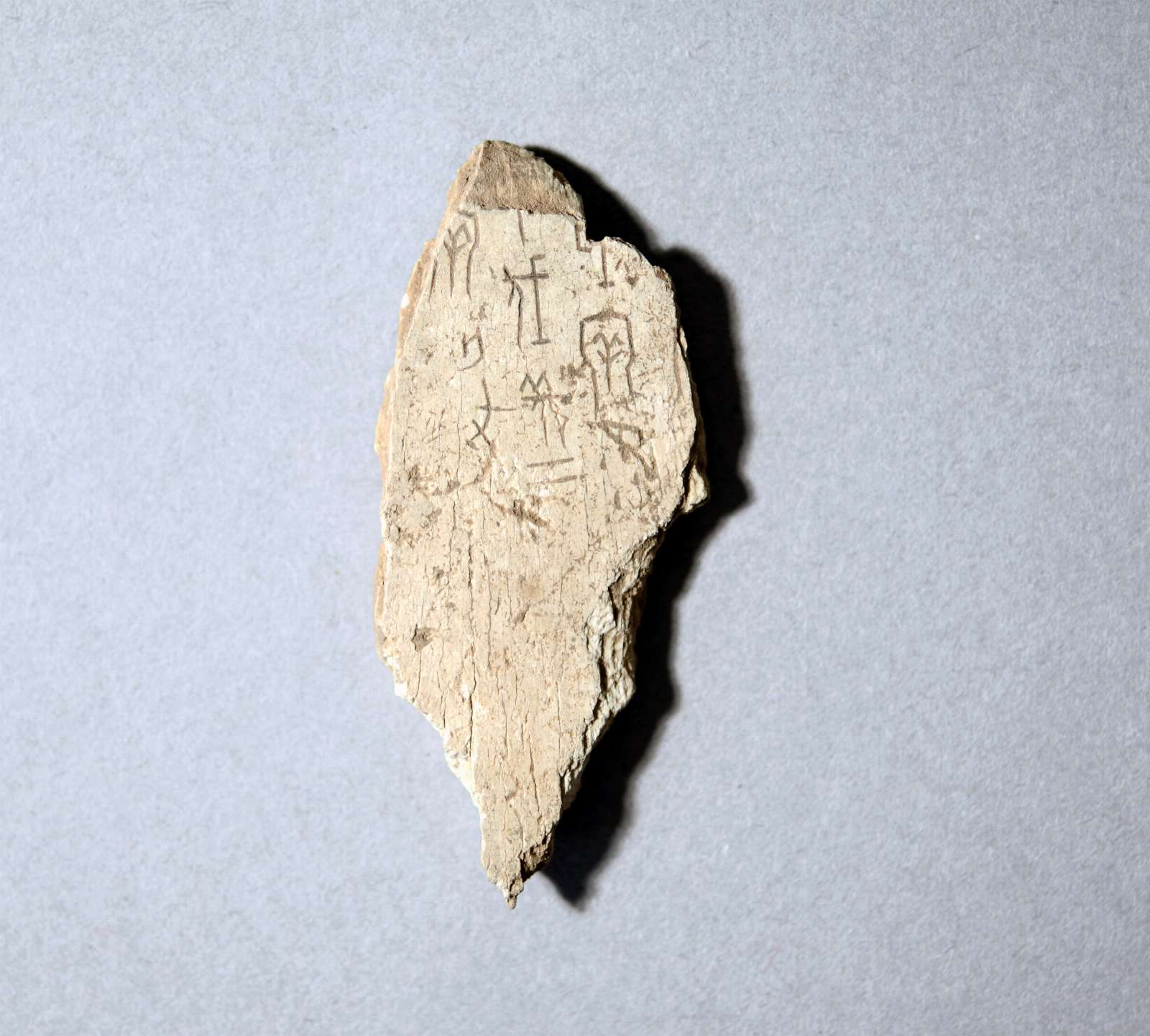
1media/362261_thumb.jpg2019-12-08T21:30:16+00:00Josh Horowitz2c316be05b4fca40b9b52441330ca6495925197312Oracle Bone 55-34-7, held at the Penn Museumplain2019-12-08T21:38:21+00:00Josh Horowitz2c316be05b4fca40b9b52441330ca64959251973
This page is referenced by:
12019-12-08T21:27:32+00:00Chapter 1: The Shang Dynasty8plain2019-12-09T02:03:13+00:00 The pictured oracle bone fragment is housed at the Penn Museum, where it is, as of the time of writing, on display. It was the subject of a minor debacle, where it was miscategorized into a collection of Sumerian artifacts and lost for several decades, but those decades passed quickly compared to the roughly three and a half millennia from its original inscription. Translated from the fragment available to us, this particular carving tells of a sacrifice of two sheep or cattle which was, ultimately, deemed auspicious [1].
The literal translation of the fragment is sparse, and might immediately be identified as simplistic or primitive, but contained within these bones and other ancient artifacts like them is not just 'the root of modern Chinese', but instead a living language of its own. The Chinese spoken and written during the Shang dynasty was as complete and as valid a language as Russian or Thai or Swahili is today, and to think of it solely as a precursor does it a disservice.
Literacy was very likely limited during the Shang dynasty when this bone was carved. Unlike the more common inscribed objects from the Zhou and later, Shang artifacts are limited, and mostly without written text. The scapulomancy and engraving would have been done by the upper echelons of Shang society, the priests and the nobility, including the king himself [2]. Unfortunately, our ability to speak definitively about literacy and literate populations in history is kneecapped by our distance, a problem that grows only more pronounced as the clock turns backwards.
Some evidence of scribal training can be gleaned from our archeological record, though. There are bone fragments with repeated carvings in variously skilled hands, and no evidence of having been used in a divining ritual [3]. The relatively limited scope of this evidence, and the overwhelming concentration of Shang writing in and around the Anyang area nevertheless implies that the literate population was minimal and concentrated around the King [4], having not yet spread as it would in later dynasties.
1. Victor H. Mair, The Case of the Wayward Oracle Bone 2. David Keightley, Sources of Shang History (University of California Press, 1978), 6 3. Adam Smith, Writing and Literacy in Early China (University of Washington Press, 2011), 188 4. Smith, Writing and Literacy in Early China, 205